


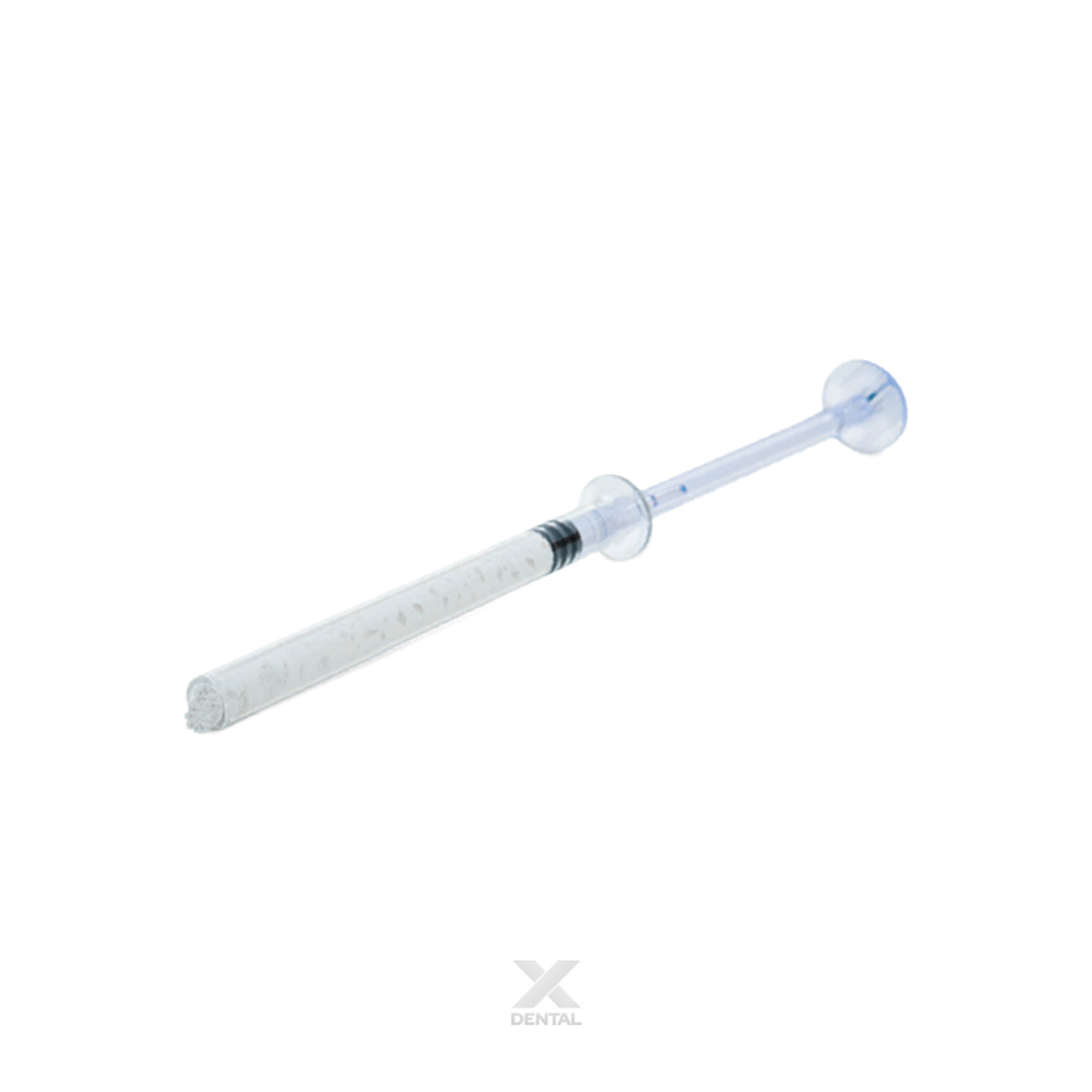

Synthetic Bone
Moldable Putty
RESORBA® Synthetic Bone Putty is a moldable, fully synthetic bone graft substitute based on Micro-Macroporous Biphasic Calcium Phosphate (MBCP®) technology. It combines fine MBCP® granules (80–1000 µm) pre-mixed with a resorbable hydrogel carrier — giving a ready-to-use, shape-retaining consistency that is delivered straight from the syringe and moulded to the bone defect. The biphasic ceramic combines the slow-resorbing stability of hydroxyapatite with the fast bioactivity of ß-tricalcium phosphate to provide an osteoconductive scaffold that is gradually replaced by the patient's own bone.
What clinicians are saying
Real-world feedback from implant and oral surgeons using RESORBA® Synthetic Bone Putty in their practices.
"The putty consistency is what makes this my go-to for irregular and contained defects — it stays where I place it and adapts to the walls of the defect rather than scattering during placement. Delivering it straight from the syringe means no mixing bowl and very little waste, and a faster set-up. For contained ridge and socket work it's become the format I reach for first."
"What reassures me is that the moldability doesn't come at the cost of the biology — it's the same biphasic ceramic scaffold, so I get the early activity from the ß-TCP and the volume stability from the hydroxyapatite. At re-entry the graft has clearly been working with the site rather than sitting there as inert filler, and the moldable form made adaptation to the defect straightforward."
The biphasic MBCP® principle
Two calcium phosphates, each with a distinct role — engineered to work together for a graft that is gradually replaced by living bone.
Chemically similar to the mineral phase of natural bone, HA is biocompatible and slow-resorbing. It grants long-term volume stability and a stable scaffold for cell adhesion.
More soluble and with fast bio-reactivity, the ß-TCP fraction enhances the ingrowth of pluripotent regenerative cells and triggers new bone formation.
Released calcium and phosphate ions stimulate osteoid formation by migrating osteoblasts — so the biphasic graft is gradually replaced by the patient's own bone.
When to use RESORBA® Synthetic Bone Putty
A moldable synthetic graft across the full range of oral bone augmentation procedures — its putty consistency is well suited to contained and irregular defects.
Structure, healing & clinical track record
Micro-macroporous architecture and histological findings that show gradual graft replacement by vital bone, supported by a long clinical record.
① Micro-macroporous structure for maximum permeability

RESORBA® Synthetic Bone vs. Human Bone (SEM)

Interconnected Macropores (SEM)
- The MBCP® structure provides a minimum 70% global porosity — comparable to cancellous bone, colonised by the body's own cells
- Interconnected macropores promote biological infiltration and cellular colonisation by osteoblasts and osteoclasts
- Micropores — the intercrystalline spaces where dissolution and recrystallisation occur — support resorption and remodelling
- High specific surface area (SSA) for maximum permeability
② New bone formation & gradual replacement

6 months post-op — sinus augmentation (×100)

10 months post-op — sinus augmentation (×400)
- At 6 months, MBCP® particles are embedded in newly formed bone, with marrow space filled by loose connective tissue and abundant blood vessels
- At 10 months, grafted material and vital bone are in close contact, with visible osteocytes and a clear reversal line in the newly formed bone
- Over the healing period, new bone increases as the graft gradually resorbs — a balance of resorption and bone ingrowth
③ A proven clinical track record
- Moldable bioceramics in maxillofacial surgery: a highly kinetic process of resorption and bone ingrowth was achieved within a few months, with new bone that was well architectured and vascularised (Guy et al., 2017)
- Human maxillary sinus augmentation: MBCP® performed predictably as a sinus-floor grafting material — alone or combined with other grafts — in the posterior maxilla (Lee et al., 2008)
- Five-year follow-up: data confirmed the time-dependent resorbability of MBCP® and the osteoconductive scaffold effect, balancing resorption with bone ingrowth (Rodríguez et al., 2008)
- Backed by more than 30 years of clinical experience and over 1 million units manufactured
Real-world clinical outcome
Case with kind permission of Juraj Brozović (DMD, PhD, Asst. Professor, Specialist in Oral Surgery) — demonstrating RESORBA® Synthetic Bone Putty in a lateral maxilla augmentation.
Lateral Maxilla Augmentation
Alveolar ridge atrophy after extraction, grafted with RESORBA® Synthetic Bone Putty (previously mixed with autologous bone) — outcome at 5-month follow-up

Alveolar ridge atrophy after extraction

Open exposure of the defect site

Putty placed after mixing with autologous bone

Post-op CT at 5-month follow-up
This product
RESORBA® Synthetic Bone Putty, supplied ready to use in a pre-filled syringe.

| Form | Granule Size | Content / Box |
|---|---|---|
| Moldable putty (MBCP®) | 80–1000 µm (0.08–1.0 mm) | 1 syringe, 0.5 mL |
Technical specifications
| Device type | Resorbable synthetic bone graft substitute (bone void filler) — moldable putty |
| Technology | Micro-Macroporous Biphasic Calcium Phosphate (MBCP®) |
| Composition | Biphasic Calcium Phosphate (MBCP®) — Hydroxyapatite (HA) / ß-Tricalcium Phosphate (ß-TCP) granules, pre-mixed with a resorbable hydrogel carrier |
| Form | Moldable putty, pre-filled in a ready-to-use syringe |
| Global porosity | MBCP® structure — minimum 70% (interconnected macro- and micropores) |
| Structure | Similar to cancellous bone |
| Resorption | Gradual; total resorption time varies with defect size, location, surgical protocol, and patient health status |
| Medical device class | Class III (CE — Notified body TÜV SÜD Product Service GmbH, n° 0123) |
| Brand | RESORBA® (Advanced Medical Solutions) |
| Manufacturer | Biomatlante SA — Vigneux de Bretagne, France |
| Origin | Made in France |
Getting the most from RESORBA® Synthetic Bone Putty
Practical guidance for predictable augmentation outcomes.