



Ti-oss® Vial
Cancellous Bone Substitute
Ti-oss® is a 100% cancellous, BSE-free Australian bovine bone substitute manufactured by Chiyewon. Its multiporous structure and octacalcium phosphate (OCP)-coated surface are designed to maximise blood vessel ingrowth and support new bone formation, with published clinical and animal research showing performance comparable to a leading deproteinized bovine bone mineral. Available in Vial and Syringe formats across three particle size ranges.
What clinicians are saying
Real-world feedback from implantologists and oral surgeons using Ti-oss® in their practices.
"For lateral window sinus grafts, what stands out with Ti-oss is how quickly the granules wet out — a few drops of blood or saline and the whole graft is saturated, so packing the cavity is fast and the material stays where I put it. The bone cores I've reviewed at re-entry show solid integration, consistent with the published pilot data."
"I was cautious about moving away from a product I'd used for years, but the calvarial defect data showing comparable new bone formation to the industry standard DBBM at both 8 and 12 weeks gave me the confidence to trial Ti-oss in ridge preservation cases. Healing and graft incorporation have tracked with what I'd expect."
Clinical Documentation
When to use Ti-oss®
Ti-oss® covers the core range of bone grafting indications — from socket preservation at the time of extraction to maxillary sinus augmentation ahead of implant placement.
Test data & animal studies
Ti-oss® performance is supported by manufacturer testing across microstructural and animal studies, and by independent human biopsy cases.
① Multiporous Structure & Osteoconductive Surface
Multiporosity

Osteopromoting Factor

- Made from 100% cancellous bone with no cortical portion — an innovative pulverising technique creates a multiporous structure designed to maximise blood vessel ingrowth
- A pre-hydroxyapatite (Pre-HA) structure — octacalcium phosphate (OCP) crystals — is present on the particle surface, a feature associated with fast bone formation in manufacturer testing
- Low-temperature processing preserves a natural, human bone-like surface topography while avoiding the vitrification associated with high-temperature manufacturing methods
② Multiporosity, Pore Size & Natural Topography — Animal Comparison
Ti-oss® vs. Competitor — Rabbit Tibia, 12 Weeks

- Angiogenesis supported by porosity design
- Osteoblast movement supported by natural surface topography
- Faster bone formation supported by the Pre-HA (OCP) surface structure
- Source: Chiyewon Ti-oss® Product Brochure — rabbit tibia model, 12-week evaluation
③ Human Biopsy Results
3 Months & 4 Months Biopsy Findings

Clinical human biopsy case reports from multiple implant centers
- Across multiple independent clinical cases, biopsy specimens taken between 3 and 4 months after grafting showed new bone formation directly adjacent to Ti-oss® particles, with osteocyte lacunae visible within the newly formed bone
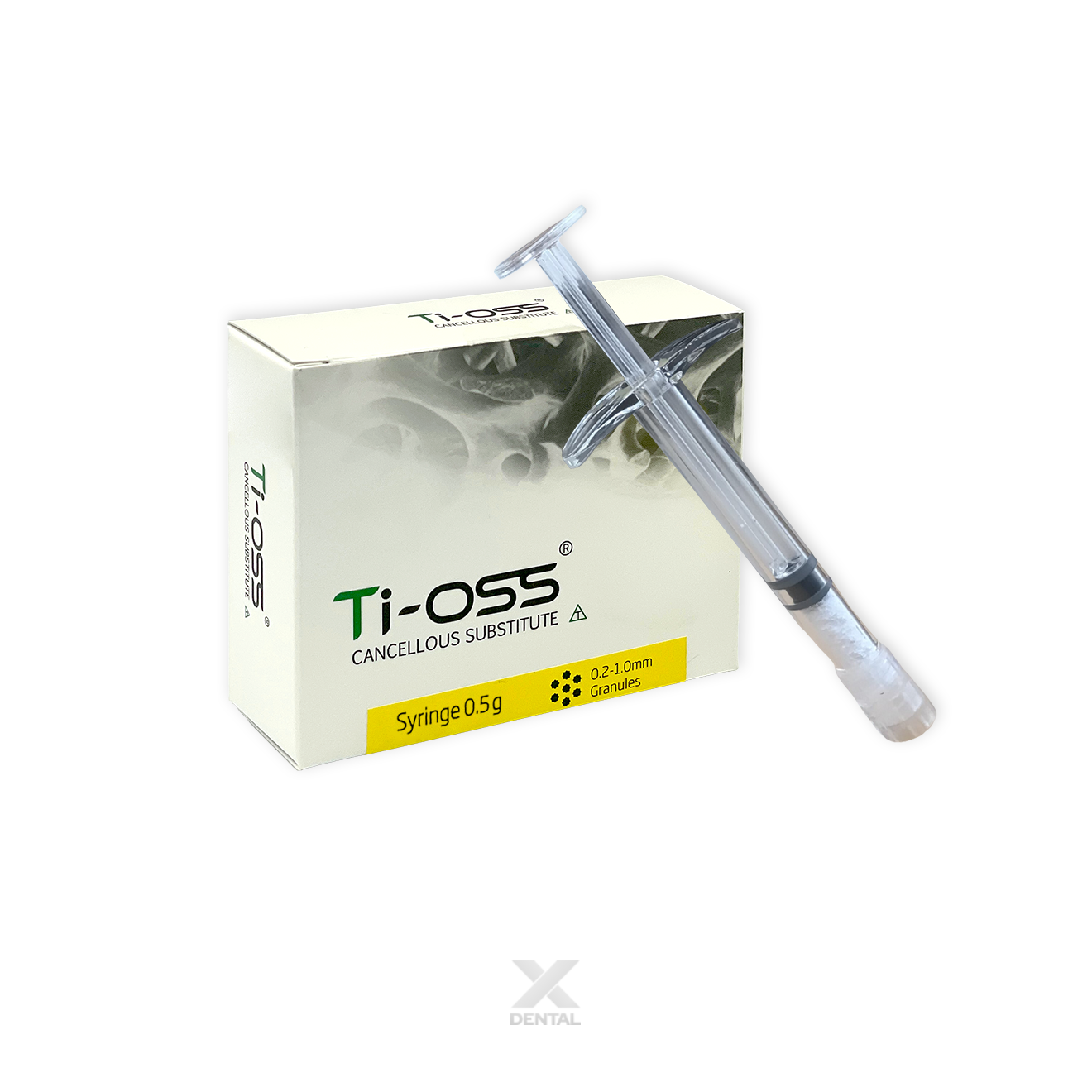
Ti-oss® Vial & Syringe — size options
Ti-oss® is supplied in three particle size ranges to suit different defect types, in both Vial and pre-filled Syringe formats.
Ti-oss® Syringe
| SKU | Weight / Volume | Particle Size |
|---|---|---|
| S25-0210 | 0.25 g / 0.55 cc | 0.2 – 1.0 mm |
| S05-0210 | 0.50 g / 1.10 cc | 0.2 – 1.0 mm |
| S25-0512 | 0.25 g / 0.60 cc | 0.5 – 1.2 mm |
| S05-0512 | 0.50 g / 1.20 cc | 0.5 – 1.2 mm |
| S25-1217 | 0.25 g / 0.75 cc | 1.2 – 1.7 mm |
| S05-1217 | 0.50 g / 1.50 cc | 1.2 – 1.7 mm |
Ti-oss® Vial
| SKU | Weight / Volume | Particle Size |
|---|---|---|
| 25-1217 | 0.25 g / 0.75 cc | 1.2 – 1.7 mm |
| 25-0512 | 0.25 g / 0.60 cc | 0.5 – 1.2 mm |
| 25-0210 | 0.25 g / 0.50 cc | 0.2 – 1.0 mm |
| 20-1217 | 2.00 g / 6.00 cc | 1.2 – 1.7 mm |
| 20-0512 | 2.00 g / 4.50 cc | 0.5 – 1.2 mm |
| 20-0210 | 2.00 g / 4.10 cc | 0.2 – 1.0 mm |
| 10-1217 | 1.00 g / 3.00 cc | 1.2 – 1.7 mm |
| 10-0512 | 1.00 g / 2.30 cc | 0.5 – 1.2 mm |
| 10-0210 | 1.00 g / 2.10 cc | 0.2 – 1.0 mm |
| 05-1217 | 0.50 g / 1.50 cc | 1.2 – 1.7 mm |
| 05-0512 | 0.50 g / 1.20 cc | 0.5 – 1.2 mm |
| 05-0210 | 0.50 g / 1.10 cc | 0.2 – 1.0 mm |
Technical specifications
| Device type | Xenograft bone graft material — deproteinized bovine bone mineral (DBBM), octacalcium phosphate (OCP)-coated |
| Material origin | 100% cancellous bovine bone, BSE-free certified, sourced from Australia |
| Surface treatment | Octacalcium phosphate (OCP) coating — Pre-HA surface structure |
| Particle size ranges | 0.2 – 1.0 mm · 0.5 – 1.2 mm · 1.2 – 1.7 mm |
| Available formats | Vial · Syringe |
| Macropore size | 300–400 µm (SEM analysis, published research) |
| Manufacturer | Chiyewon Co., Ltd. — Gyeonggi-do, Korea |
| Origin | Made in Korea |
Getting the most from Ti-oss®
Practical guidance for predictable grafting outcomes.